
In this article
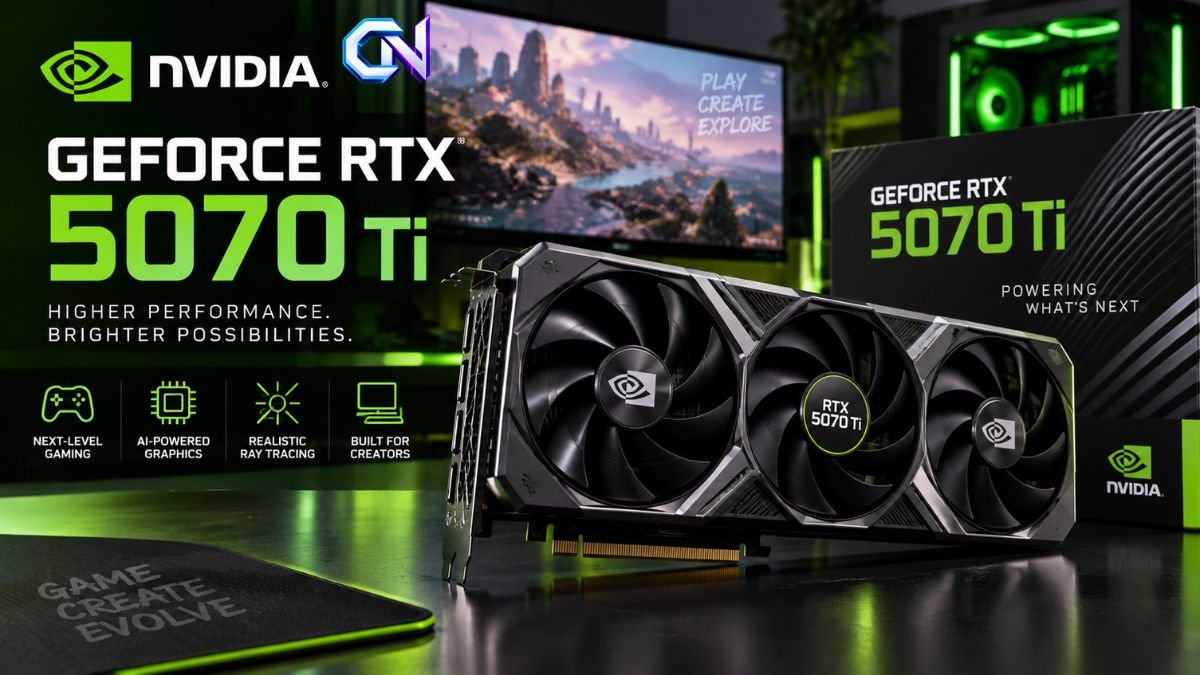
The RTX 5070 Ti is a high-end desktop graphics card based on NVIDIA’s Blackwell architecture. Released on February 20, 2025, it launched at an NVIDIA suggested price of $749 in the US and £729 in the UK, although actual prices depend on the board manufacturer and retailer. Its key hardware includes 8,960 CUDA cores, 16GB of GDDR7 memory on a 256-bit interface, a 2.45GHz reference boost clock and a 300W total graphics power rating.
Independent testing places the card around the performance class of the previous-generation RTX 4080, making it particularly relevant for high-refresh-rate 1440p gaming and demanding 4K workloads.
RTX 5070 Ti Specifications
The 5070 Ti sits between the RTX 5070 and RTX 5080 in NVIDIA’s desktop GeForce RTX 50-series range.
Its core specifications are:
| Specification | RTX 5070 Ti |
|---|---|
| Architecture | NVIDIA Blackwell |
| CUDA cores | 8,960 |
| Base clock | 2.30GHz |
| Boost clock | 2.45GHz |
| Memory | 16GB GDDR7 |
| Memory interface | 256-bit |
| Tensor Cores | Fifth generation |
| Ray Tracing Cores | Fourth generation |
| AI performance | 1,406 AI TOPS |
| RT performance | 133 TFLOPS |
| Total Graphics Power | 300W |
| Recommended system power | 750W |
| Interface | PCI Express Gen 5 |
| NVENC | 2x ninth generation |
| NVDEC | 1x sixth generation |
| AV1 encoding/decoding | Yes |
Card dimensions are not fixed because NVIDIA did not produce a standard Founders Edition version of the 5070 Ti. Instead, the GPU is sold through add-in-board partners, meaning cooler size, slot thickness, factory clock speeds and physical dimensions vary between models.
Manufacturers offering cards have included ASUS, Gigabyte, MSI, PNY, Palit, Zotac and other NVIDIA partners.
16GB of GDDR7 Memory Is an Important Part of the Design
One of the most significant hardware characteristics is the combination of 16GB of GDDR7 VRAM and a 256-bit memory interface.
This provides substantially more memory bandwidth than the original RTX 4070 Ti, which used 12GB of GDDR6X on a 192-bit interface. The later RTX 4070 Ti Super also had 16GB and a 256-bit bus, so the difference between that model and the 5070 Ti is less dramatic.
The 16GB capacity is particularly relevant when running modern games at high resolutions, using high-resolution texture packs, working with complex 3D scenes or handling GPU-accelerated creative applications.
Memory capacity alone does not determine performance, however. Game engine behaviour, resolution, graphics settings, ray tracing and CPU performance can all affect results.
How Fast Is the RTX 5070 Ti?
Independent testing shows that the RTX 5070 Ti is primarily suited to high-end 1440p and 4K gaming.
Ars Technica’s launch testing found its general performance to be close to the RTX 4080 and RTX 4080 Super. Across its test suite, the card commonly delivered around 90% of the RTX 5080’s performance.
The generational improvement depends heavily on which older GPU is used for comparison.
Against the RTX 4070 Ti Super, Ars Technica recorded improvements ranging from roughly 8% to 20% in its 4K tests. Compared with the original RTX 4070 Ti, improvements varied more significantly, with some tested games showing gains between approximately 20% and 50%.
The wider difference against the original 4070 Ti can partly be explained by that card’s smaller 12GB memory capacity and narrower memory interface.
Tom’s Hardware reached a similar general assessment, describing the 5070 Ti as particularly capable at native 1440p while also being suitable for 4K, especially when upscaling technologies are used.
Actual frame rates vary substantially by game, settings and system configuration, so no single FPS figure accurately represents the card across all software.
Blackwell, Ray Tracing and AI Hardware
The GPU uses NVIDIA’s Blackwell architecture, which introduced fifth-generation Tensor Cores and fourth-generation RT Cores to the GeForce desktop range.
Tensor Cores accelerate AI-related workloads and technologies such as DLSS, while RT Cores are specialised hardware designed to accelerate ray-tracing calculations.
Ray tracing simulates the behaviour of light to provide effects such as more realistic reflections, shadows and global illumination. Path tracing takes the concept further by modelling a larger portion of scene lighting, but it is also significantly more computationally demanding.
This is why NVIDIA combines its ray-tracing hardware with DLSS technologies rather than relying entirely on conventional native rendering in the most demanding games.
DLSS and Multi Frame Generation
The RTX 50 generation launched with DLSS 4, including Multi Frame Generation.
Traditional rendering requires the GPU to render each displayed frame. Multi Frame Generation instead uses AI to create additional frames between conventionally rendered frames, allowing supported games to display a higher output frame rate.
It is important to distinguish generated frames from native rendering performance. Frame generation does not make the GPU’s underlying rendering workload disappear, and the quality of the experience still depends on the starting frame rate, game implementation and latency.
NVIDIA’s current RTX 5070 family documentation also promotes newer DLSS capabilities for RTX 50-series cards, including Dynamic Multi Frame Generation and DLSS 5 technologies where supported.
Support remains dependent on individual games and software implementations rather than applying automatically to every title.
Display Support Is Built for High-Refresh Monitors
The card supports modern display standards, including DisplayPort 2.1b and HDMI 2.1b.
NVIDIA’s reference specification allows three DisplayPort connections and one HDMI connection, although buyers should still check the ports provided by the specific partner card they intend to purchase.
With Display Stream Compression, NVIDIA lists support for configurations reaching up to 4K at 480Hz or 8K at 165Hz through appropriate DisplayPort configurations.
Those specifications describe the maximum supported display interface capabilities. They do not mean modern games will necessarily run at hundreds of frames per second at 4K or 8K. Rendering performance and display bandwidth are separate considerations.
Up to four displays are supported.
Power Supply Requirements
The RTX 5070 Ti has a 300W Total Graphics Power rating.
NVIDIA specifies a 750W recommended system power figure based on a system configured with an AMD Ryzen 9 9950X. NVIDIA also notes that the actual requirement can change depending on the rest of the PC.
Power can be supplied through either an appropriate PCIe Gen 5 power cable or two PCIe eight-pin cables using the adapter supplied with compatible cards.
Anyone upgrading an existing gaming PC should check more than the wattage number. The power supply should provide the necessary connectors, while the case needs enough physical space for the specific graphics card.
Because NVIDIA leaves the 5070 Ti’s physical dimensions to board partners, some triple-fan versions can be considerably larger than others.
The RTX 5070 Ti for Video Editing and Creative Work
The GPU is not limited to games.
NVIDIA equips it with two ninth-generation NVENC hardware encoders and a sixth-generation NVDEC decoder. It supports hardware AV1 encoding and decoding, which is useful for compatible video-editing, recording and streaming workflows.
NVIDIA’s Blackwell generation also added support for professional 4:2:2 video formats in its newer media engine.
Applications including Adobe Premiere Pro, DaVinci Resolve and supported 3D rendering software can take advantage of NVIDIA GPU acceleration, although the performance benefit depends on the application, codec and individual workload.
The 16GB VRAM capacity can also be valuable for complex creative projects and some local AI workloads where memory requirements exceed those of lower-capacity graphics cards.
RTX 5070 Ti vs RTX 4070 Ti Super
The comparison with the RTX 4070 Ti Super is particularly important because both cards have 16GB of memory and a 256-bit bus.
The newer model moves from Ada Lovelace to Blackwell and from GDDR6X to GDDR7. It also gains the RTX 50-series generation of Tensor, ray-tracing and video-processing hardware.
However, the improvement in conventional game rendering is more evolutionary than transformative. Independent 4K testing showed an approximately 8–20% advantage in the games tested by Ars Technica.
That means an upgrade is much easier to justify from an older or slower GPU than from an RTX 4070 Ti Super that already meets a user’s performance requirements.
Price and Availability
NVIDIA introduced the card at $749 in the United States, while its UK site listed a £729 MSRP.
Unlike some other RTX 50-series GPUs, there is no NVIDIA Founders Edition 5070 Ti. Retail models come from NVIDIA’s board partners, and those companies can charge different prices for larger coolers, factory overclocks and premium designs.
Street prices should therefore be checked at the time of purchase rather than assuming every card will match NVIDIA’s original MSRP.
This also affects comparisons with alternatives. A GPU that offers attractive price-to-performance value at the official launch price can become substantially less competitive if a particular partner model is priced far above it.
For buyers choosing between GPUs, comparing the actual retail prices of available cards is more useful than relying solely on their original launch prices.
Who Is the RTX 5070 Ti Designed For?
Its specifications and independent benchmark results make the card most relevant to users targeting high-refresh 1440p gaming, 4K gaming, ray tracing or GPU-accelerated creative workloads.
Its 16GB memory capacity and strong memory bandwidth are also better suited to demanding high-resolution workloads than cards with smaller VRAM allocations.
For existing RTX 4070 Ti Super owners, conventional rendering improvements are comparatively modest. For users coming from older generations, however, the performance difference can be considerably larger while also adding newer Blackwell, media-engine and frame-generation capabilities.
The final purchasing decision depends heavily on real retail pricing, because NVIDIA’s $749/£729 figures are suggested launch prices rather than a guarantee of what every partner model will cost.